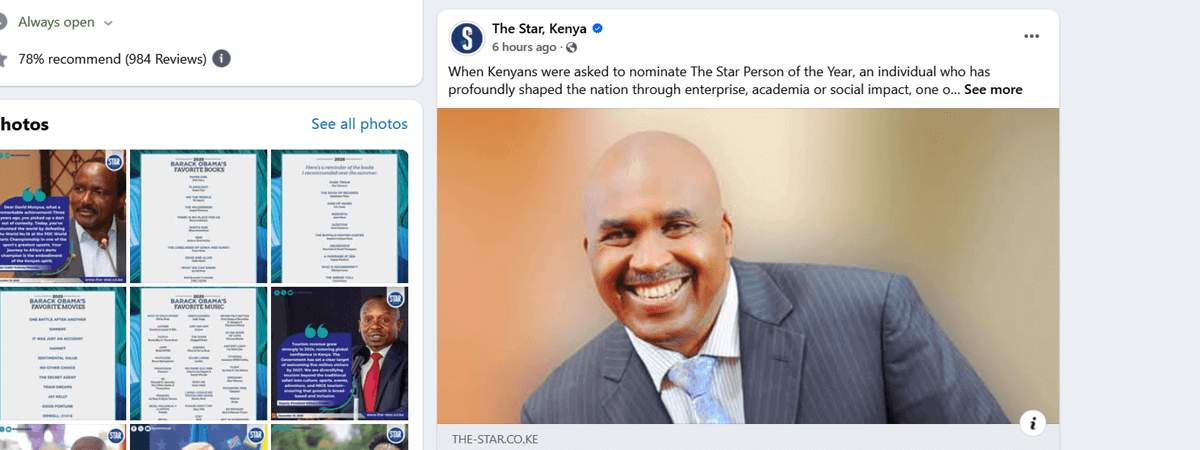
When Kenyans were asked to nominate The Star Person of the Year, an individual who has profoundly shaped the nation through enterprise, academia or social impact, one of the names that resonated strongly was that of Prof Simon Gicharu, the founder and chairman of Mount Kenya University and Mount Kigali University in Rwanda.
Gicharu has also recently founded fast-growing Cape Media that owns TV47 and Radio47.
These achievements mark the extraordinary journey of a man whose vision, focus and resilience have transformed lives across East Africa and beyond. It is not just the story of a university but the story of resilience, ideas and an unrelenting belief in the power of education to change society.
Gicharu’s entrepreneurial instinct did not sprout in tastefully furnished and air-conditioned boardrooms or in university lecture halls. It began in a day secondary school in rural Kiambu.
Growing up in Githunguri, and later attending Murang’a High School, Gicharu was already experimenting with business ideas.
“I was in a day school, and the students loved music, but there was no provision for it. So, I would bring the turntable, charge them to enter the class where they were to dance, and make some income out of that. I didn’t own a turntable, so I used to hire,” he said.
Later, while at Murang’a High, Gicharu managed the school canteen, buying bread, selling it to students and learning firsthand the basics of trade.
These early ventures planted a lasting seed. “I had an early exposure to entrepreneurship. Again, as I was doing my university education, my father was involved in timber business, small scale. I used to see how he did it and I admired his resilience.” His ambition then was to own a sawmill.
That drive to move upstream, to create opportunity rather than chase it, would later define his life’s work.
Upon graduation from Kenyatta University, Gicharu was posted by the Teachers Service Commission to Thika Technical Institute, where he taught mathematics.
Teaching gave him time to think, write and innovate. Together with colleagues, he wrote Applied Mathematics for Craft Engineering, the first Kenyan-authored mathematics book for technical institutions.
But teaching did not quench Gicharu’s thirst for bigger things. “After publishing the book, I said, what next? So, I looked at the environment around.” Observing young investors struggling to start businesses, he founded an NGO, Kenya Entrepreneurship Promotion Programme, to equip micro and small entrepreneurs with management and business skills, mainly in Kiambu and neighbouring Murang’a.
The initiative gained traction, earning him a nomination by the British Council to study Small and Micro Enterprise Development at Cranfield University School of Management in the UK.
But that opportunity came at a cost. “When I went, I didn’t have permission from my employer, so I was sacked. And I never went back. I said I would never look for a job again,” he said. From that moment, Gicharu committed himself fully to becoming an employer and a builder of institutions.
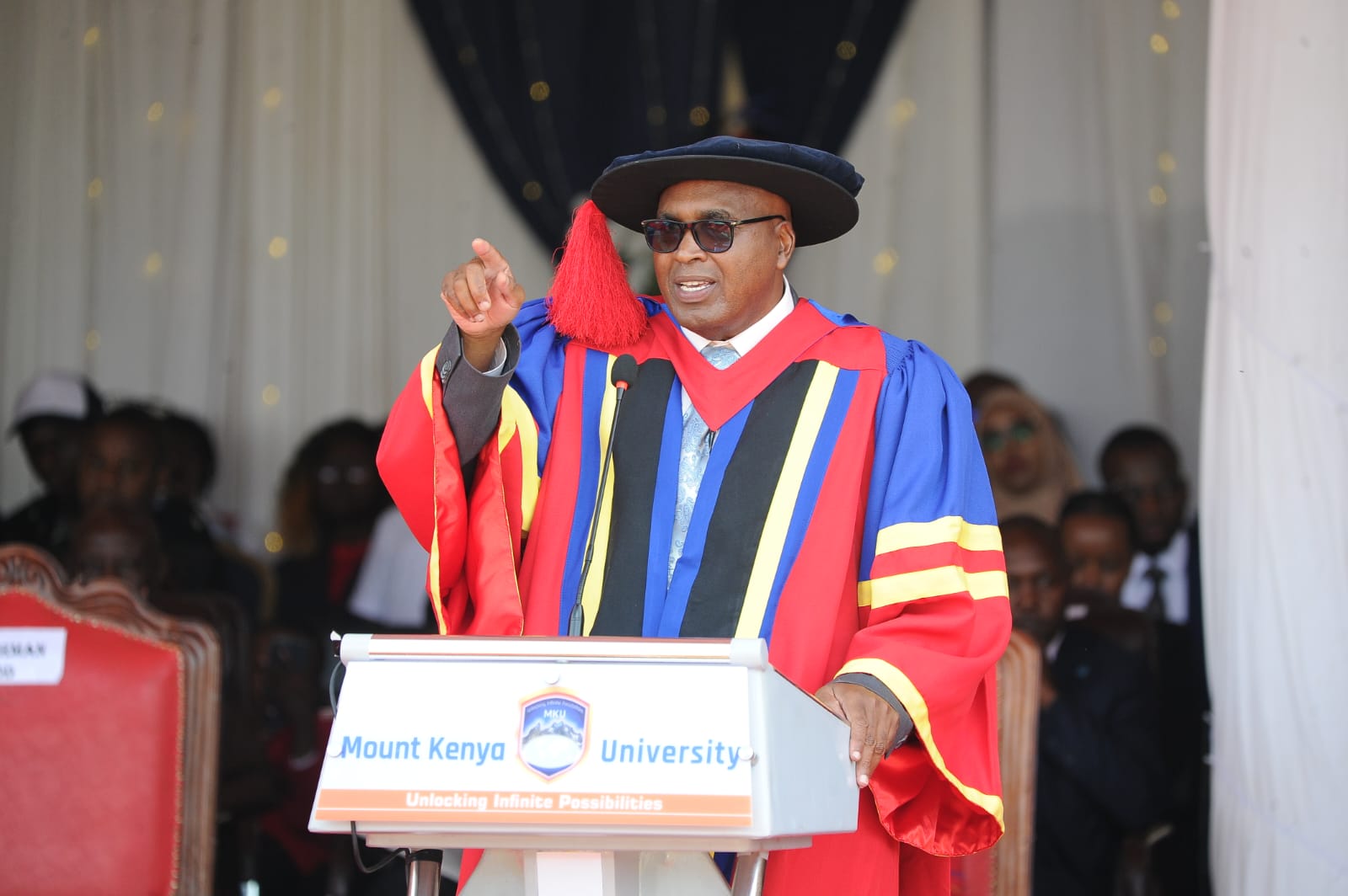
His NGO eventually evolved into the Thika Institute of Technology. “I established the commercial college combining the two skills, entrepreneurship and teaching. I grew it up to what today is Mount Kenya University in Kenya and Mount Kigali University in Rwanda,” he told the Star in an interview.
Was it all smooth sailing? “It all boils down to focus and vision,” Gicharu said. “I had the focus, of course, and the vision, but I didn’t have the money. Just like any other small and micro-entrepreneur, I had to borrow some money here and there from banks to build up on what I had.”
His first loan of Sh20,000 from Equity Bank went to buying desks. From there, growth was incremental, deliberate and disciplined. In 2011, at the age of 46, Gicharu became the first Kenyan to establish a fully chartered private university. MKU was born, not by imitation, but by identifying unmet needs.
Thika Institute had become the first private institution in Kenya to offer a diploma in pharmacy and later, MKU the first private university to offer a Bachelor of Pharmacy. It pioneered open, distance, and e-learning in the region.
Today, MKU is one of the largest universities in Eastern and Central Africa.
Central to Gicharu’s success is a philosophy that challenges conventional wisdom: money does not create ideas, ideas attract money. He points to the mass retrenchments of the 1990s, when many Kenyan workers received lump-sum payouts, the so-called golden handshakes, but they lacked viable ideas. Their businesses collapsed, savings vanished and frustration followed.
To succeed in business, the investor needs a “bankable idea”. How does one get the right idea? By identifying gaps in the market, improving what already exists, or doing what others are not doing. Entrepreneurship, in Gicharu’s view, is not about copying but germinating, taking a viable idea and nurturing it patiently.
“One of the biggest mistakes people make when starting their own enterprise, that particular day, you want to grow it, but you also want to look at others,” he said.
“When you compare yourself to Kenyatta, where I was a student, of course, it can look as if you are daydreaming. But the biggest aspect I learnt, and I was telling micro-entrepreneurs, is that don’t look at others with a view of becoming them. Become yourself, focus, grow. But if you start comparing yourself, saying, no, no, I want to become like the University of Nairobi, no, not at all.”
But business also requires resilience. Failure, Gicharu insists, is never total but contains vital lessons.
He recalls venturing into the pharmacy retail business, only to realise it was not aligned with his strengths. He closed it and moved on without regret. But even earlier, he had failed to qualify for university the first time. He repeated Form 6 and made it.
“Failure is not wholesale,” he explained. “There is always something in it that works.” Just as a student who fails in exams may excel in sports, drama or mathematics, an entrepreneur who stumbles often carries the seeds of success, if they are willing to learn.”
This conviction mirrors his views on education and underpins Gicharu’s support for the new Competency-Based Education, a system he now champions nationally as chairman of the Kenya Institute of Curriculum Development.
“One of the biggest attributes of success in entrepreneurship is resilience. You must be resilient, because if I were not, today we would not be talking about what I have done.”
Gicharu said his purpose is to change people’s lives, not to make more money. He recalls entering a plane on one of his travels and four crew members rushed towards, shouting, “It’s him!” He wondered what he had done. They were former students of his university, MKU, excited to see him.
“See, that’s more than anything else. How much can you attribute to that one? It’s not money. No. I was very happy. When I go to meet our pharmacists serving, our doctors, they are happy and they say, ‘Thank you for giving me an opportunity to study in that institution.’ It’s about that. Changing people’s lives.”
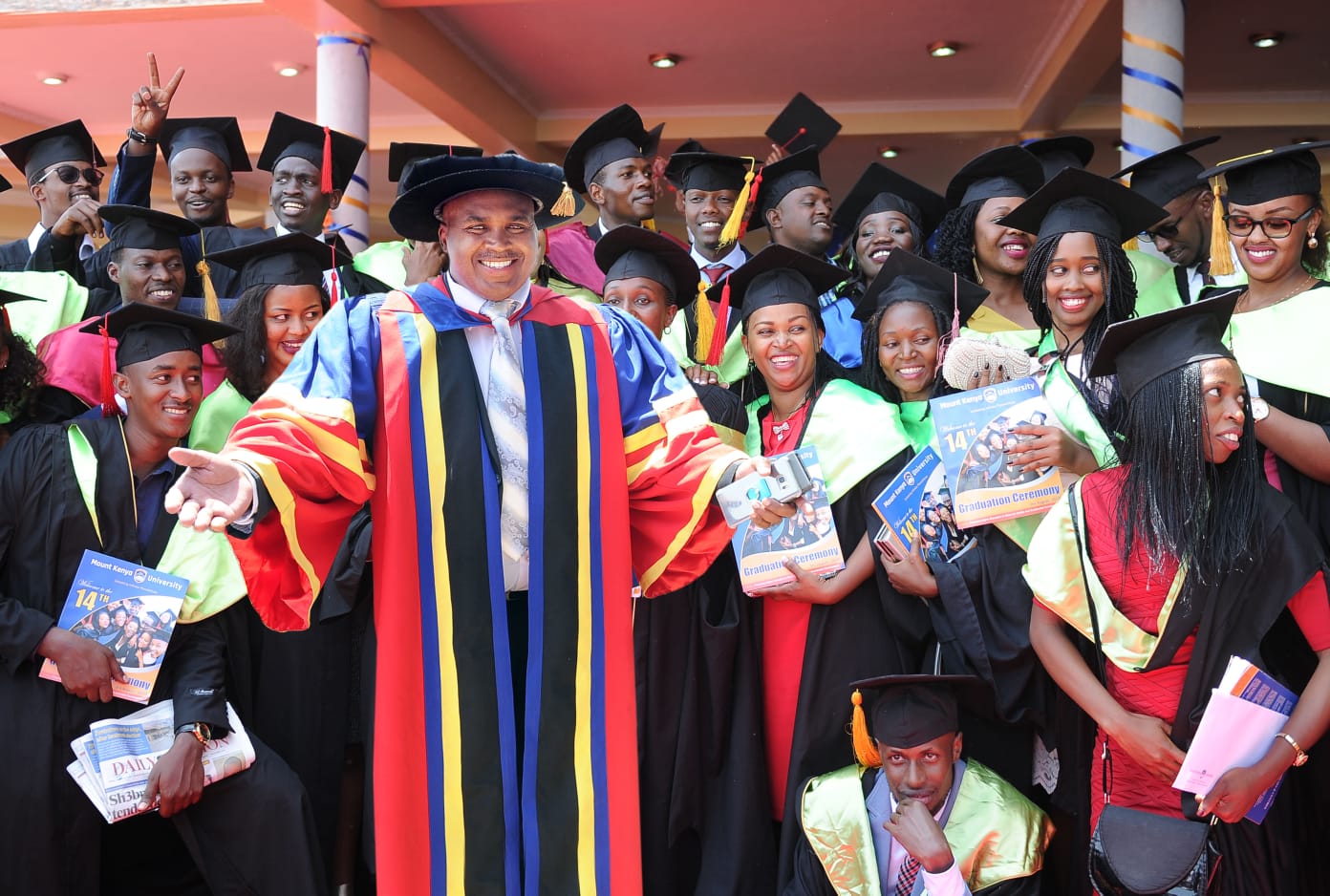
Perhaps the most powerful measure of Gicharu’s legacy is this number: 173,000. As of the most recent graduation ceremony, that is the count of students who have passed through MKU, now serving as doctors, pharmacists, engineers, educators, entrepreneurs and other professionals across Kenya and the globe.
“I get phone calls from the US, Europe, wherever,” Gicharu said. “Because you see, again, when you train people who can really beat the competition worldwide, then you are doing the right thing. So, that is what makes me happy.”
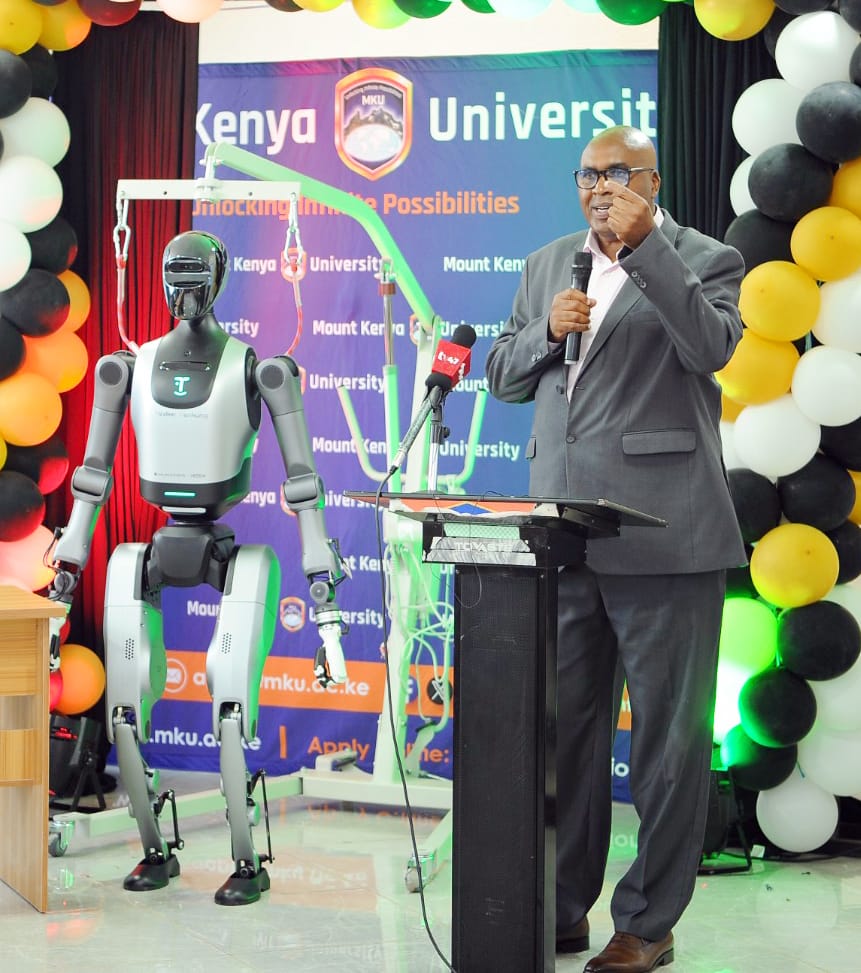
Looking ahead, MKU is positioning itself at the frontier of technology and innovation. Artificial intelligence, robotics, virtual learning, and digital platforms are no longer optional, but central to the university’s future. “The other day I went to China, I saw some robots. I told the university to buy so that it sparks the interest of training in robotics and artificial intelligence. So, basically, it’s about utilising digital technology and ensuring that we harness the same to become a centre of excellence in all areas.”
MKU already leads in e-learning enrolment, while continuing to invest in physical campuses for students who value the full university experience, including sports, drama, collaboration and community.
The institution has also expanded into media and hospitality training (with a hotel in Kigali) to ensure students graduate with real-world exposure and industry-ready skills.
Outside of work, Gicharu describes himself simply. He enjoys traveling, swimming, reading and networking with people across disciplines. He is an active member of the Presbyterian Church.
Simon Gichau’s story is about the great heights one can scale when vision meets resilience, when ideas are nurtured patiently and when success is measured by the lives transformed. He is documenting his extraordinary journey in a book he intends to publish next year.


