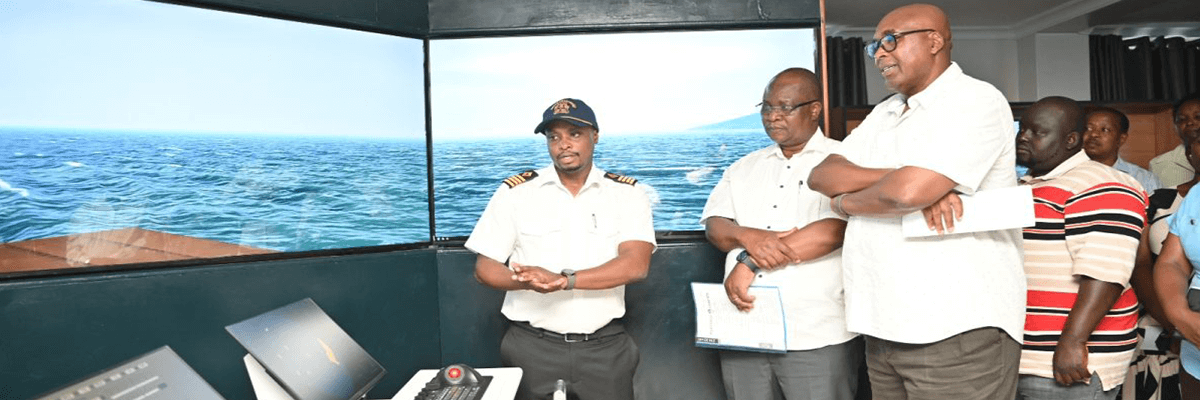
Mount Kenya University (MKU)’s Malindi Maritime Academy has boosted Kenya’s maritime training capacity with the installation of a modern bridge simulator facility valued at KSh30 million, as the institution intensifies efforts to tap into the largely underdeveloped maritime sector.
The high-tech simulator is designed to replicate real-life ship bridge operations, offering trainees practical exposure in navigation, vessel handling, safety management and emergency response under varying sea and weather conditions. “The facility will significantly enhance competency-based training and produce graduates who are ready for both local and international maritime jobs,” says Mr. John Njenga Muhia, Centre Director, Malindi Maritime Academy.
Speaking during the commissioning, Kenya Institute of Curriculum Development (KICD) Chief Executive Officer Dr. Charles Ong’ondo said the simulator aligns with the country’s shift towards practical, skills-based learning.
“Facilities like this bridge simulator are critical in ensuring learners acquire hands-on competencies that meet industry demands. We encourage institutions to invest in such infrastructure to support quality training under the competency-based framework,” said Dr. Ong’ondo.
Mr. Muhia said the university is pushing for the KSh30 million simulator to be formally recognised by relevant regulatory and accreditation bodies to allow it to be fully integrated into certified maritime training programmes.
“Our goal is to have this simulator recognised as a standard training facility so that our cadets can train locally and be competitive globally. This investment demonstrates MKU’s commitment to the blue economy and to producing highly skilled maritime professionals,” he said.
In an exciting leap towards revolutionizing maritime training in Kenya, the Academy in Malindi is now equipped with state-of-the-art Wärtsilä navigational simulators. These simulators represent the pinnacle of maritime simulation technology, designed to meet the evolving needs of a rapidly digitizing industry and preparing the next generation of seafarers for the complexities of modern maritime operations.
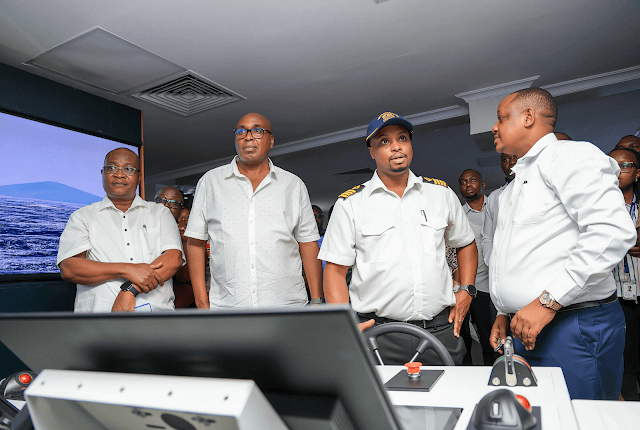
Malindi Maritime Academy is strategically positioned to support national priorities in shipping, port services and marine logistics, while reducing the cost of training Kenyan seafarers abroad.
The university has reaffirmed that its programmes are aligned with KICD standards and national education policies, as it continues to invest in modern training facilities to strengthen skills development across all levels of education.
Wärtsilä’s navigational simulators are market-leading solutions, engineered to offer high-quality, highly realistic training experiences. These advanced simulators cover abroad spectrum of maritime scenarios, ensuring that trainees receive hands-on, practical experience with authentic equipment replicas. From traditional classroom environments to immersive virtual reality experiences, these simulators offer unmatched flexibility for instructors and students alike.
“At MKU Maritime Academy, the installation of these simulators aligns perfectly with the institution’s commitment to providing world-class education, producing graduates who are fully prepared for international maritime standards,” Mr. Muhia said.
In November last year, MKU signed a landmark Memorandum of Understanding (MoU) with Abu Dhabi Maritime Academy, marking a significant step toward strengthening maritime education and training in Kenya. This partnership will enhance the capacity of MKU’s Maritime Academy in Malindi to meet the growing global demand for skilled maritime professionals. The MOU was signed by MKU Chairman and Founder, Prof. Simon Gicharu and Dr. Yasser Al Wahedi, President of Abu Dhabi Maritime Academy.
“This partnership underscores MKU’s commitment to providing world-class maritime education and positioning Kenya as a leader in the Blue Economy,” said Prof. Simon Gicharu, Chairman and Founder
“By working with Abu Dhabi Maritime Academy, we will equip our students with the skills and expertise required to thrive in the international maritime industry,” he added.
Through this collaboration, MKU aims to play a pivotal role in supporting Kenya’s broader vision to harness the full potential of the Blue Economy. “The MoU will facilitate knowledge exchange, curriculum development, internships and advanced training programs for seafarers, engineers and maritime experts professions that are critically needed to address the global shortage of maritime personnel,” said Mr. Muhia.
Kenya’s strategic location along the Indian Ocean positions the country as a natural hub for maritime activity. The MKU Maritime Academy in Malindi is strategically located to serve both local and international students, offering specialized programs that align with global standards. The collaboration will also open doors for joint research, faculty exchange, and internship opportunities, ensuring graduates are industry-ready.
This initiative reflects MKU’s dedication to innovation and excellence in education, while contributing to Kenya’s economic growth and sustainable development goals. Since its inception MKU maritime Academy has trained many seafarers and have continuously added their programmes from offering Basic STCW course to offering more advanced and competitive courses.


