
BY EVANS ONGWAE
Across Kenya, doctoral students often struggle to complete their studies and graduate within the stipulated time. Juggling learning with work, family commitments, and other social engagements often become overwhelming, leading to delayed completion of coursework and projects.
The result, nationally, is the production of fewer PhD graduates every year than the country needs for its development goals.
Mount Kenya University (MKU) Vice-Chancellor Prof Deogratius JAGANYI says the institution has moved to address this longstanding challenge. It has reimagined postgraduate training as it goes on to produce the next generation of researchers.
“We have put in place a framework that supports each postgraduate cohort to progress together instead of the majority being left far behind as normally happens,” he explains.
Prof JAGANYI adds that the university has gone further to ensure postgraduate students’ theses become bankable ideas – gems that can be polished to shine brightly in front of prospective funders. “To graduate, all our PhD students must publish their research in international peer reviewed journals. Period,” he stresses.
MKU’s learner-centred postgraduate training model integrates research, mentorship, scholarly engagement and publication in peer-reviewed indexed journals. The approach, asserts Prof JAGANYI, seeks to produce not only graduates, but also competent researchers, innovators and thought leaders who are capable of addressing local and global challenges.

Grounded in apprenticeship, mentorship and scholarly socialisation frameworks, the model views postgraduate education as a process of knowledge production and co-creation rather than knowledge consumption. Students learn through active participation in research communities and scholarly practice.
The don observes: “PhD students are the drivers of research in highly ranked universities globally. Such research must be published in high-quality journals that enjoy international recognition. Our goal is not merely to graduate students, but to produce scholars whose research contributes to solving real-world challenges and advances the global body of knowledge.”
MKU Deputy Vice-Chancellor for Academic and Research Affairs, Dr Mercyline Kamande, says the university has redesigned its doctoral programmes to align them with global best practice in research training. She asserts that this is important as Kenya seeks to expand its pool of doctoral graduates to meet national needs.
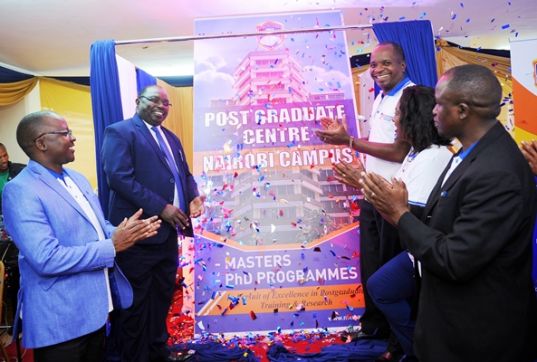
Principal of the College of Graduate Studies and Research at MKU, Dr Henry Yatich, says the university has institutionalised clear milestones for both Master’s and PhD students to ensure systematic and efficient academic progression.
Adding his voice to the discussion, the Director of Graduate Studies, Dr Samuel Karenga, states: “The new model of blending coursework with seminars ensures that students move together as a cohort. It helps fast-track academic progression while encouraging peer support and accountability.” He adds: “Students challenge and motivate each other to complete their studies together, just as they began together.”
eongwae@ke.nationmedia.com


